
The Architecture of Perception: What Freediving Reveals About Consciousness
An unexpected encounter with nitrogen narcosis, and a reflection on the extraordinary relationship between physiology, perception and the human mind.
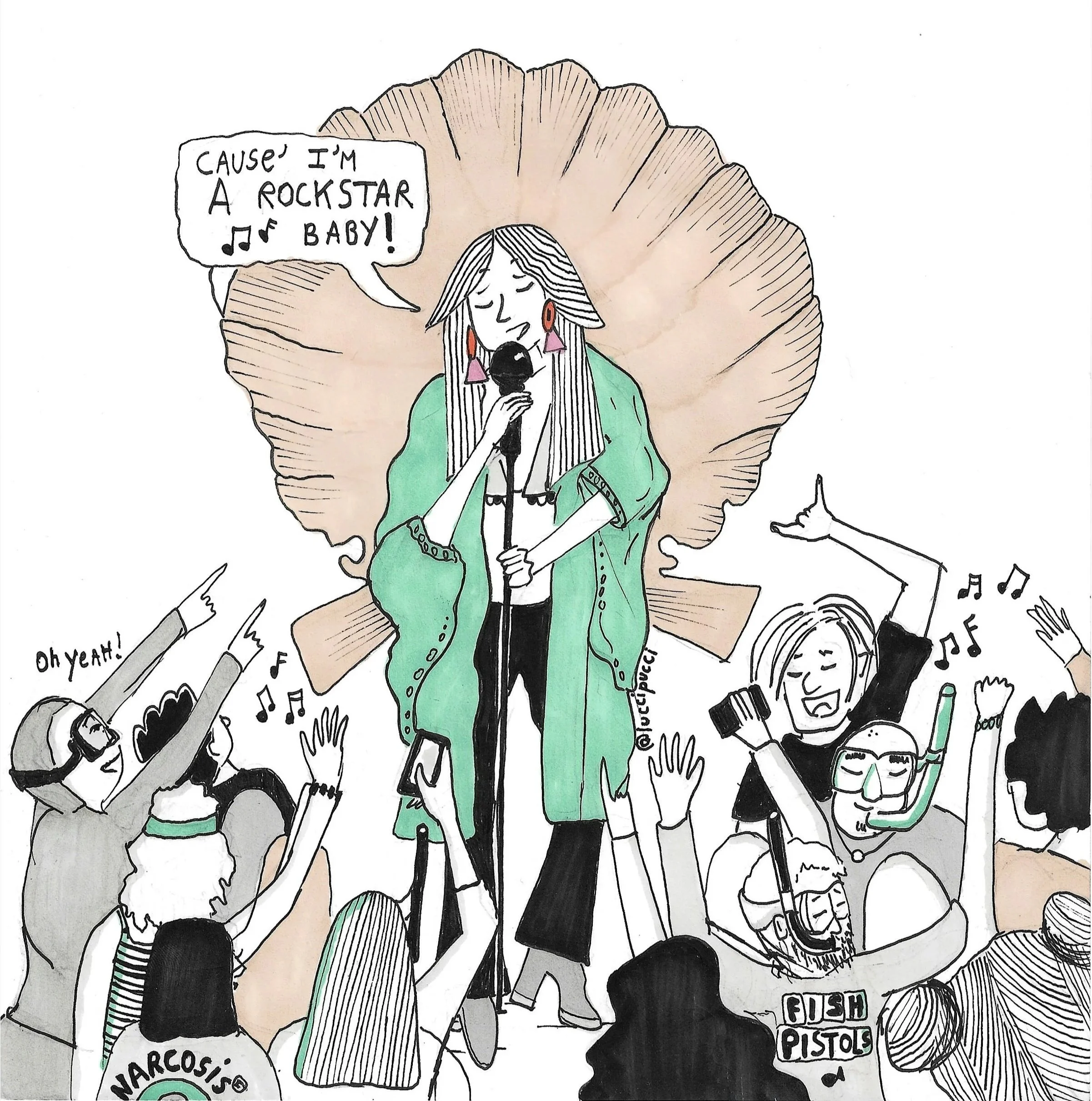
At 86 metres beneath the surface of the Red Sea, I became a rockstar.
I was standing on a stage, an electric guitar in my hands, surrounded by flashing lights and an ecstatic crowd. I could almost feel the strings beneath my fingers. Everything was extraordinarily vivid, emotionally charged and, in that moment, perfectly logical.
Except that I was nowhere near a stage.
I was freediving in the Blue Hole in Dahab, Egypt, on a single breath.
It was my first encounter with narcosis, and one of the most extraordinary experiences of my sporting career.
From curiosity to purpose
The summer of 2021 marked a quiet turning point in my life.
Through training and competitions, I began to get to know several athletes from the Italian national freediving team. People I had previously admired from a distance suddenly no longer seemed so unreachable.
In September, during a competition in Cefalù, Sicily, I validated new depths and finished second behind Alessia Zecchini.
Standing on that podium was surreal. But more importantly, it planted a question in my mind: what if this wasn't just an isolated experience?
Shortly afterwards, I travelled to Kaş, Turkey, to attend the CMAS World Championships as a spectator.
I observed everything: the anticipation, the tension before the dives, the blackouts, the euphoria and the pressure of competition.
For the first time, I began to imagine myself on the other side of the rope, not as a spectator, but as an athlete.
What struck me was how much of the difference between myself and those athletes lay in their daily habits. Structured training, discipline, attention to recovery, nutrition and sleep. Small, deliberate choices repeated over time.
The seed had been planted. Now it had roots.
I returned to Dahab to train with Gus Kreivenas and the Touchdown team, supported by a new sense of purpose: I wanted to become part of the Italian national depth freediving team.
My body was adapting, my motivation was clear, and I was reaching depths that had once seemed unimaginable.
By the end of October 2021, I had reached 86 metres in constant weight with a monofin.
And that was when I discovered an entirely different dimension of freediving.
The rockstar at 86 metres
The descent began as it always did: slow, silent and regular.
As freefall took over and the Blue Hole grew darker around me, something began to change. The water no longer felt quite like water. The world became heavy, muffled and dreamlike.
The contours of reality began to dissolve.
Suddenly, I was on a stage, an electric guitar in my hands. In front of me, an ecstatic crowd. Lights flashing. I was a rockstar about to perform the concert of a lifetime.
It was so vivid that I could almost feel the strings beneath my fingers. And, strangely, it made perfect sense.
That rockstar version of myself was not entirely a fantasy. It was an old, buried dream that had never really been given space to develop in my everyday life.
Yet there, somewhere beneath the surface of the Red Sea, it had come alive.
I returned safely to the surface and, as my ordinary perception returned, I laughed.
Not because the experience had been ridiculous, but because it had been so unexpected, surreal and strangely beautiful.
It left me wondering: how much of our experience of reality is constructed by our own physiology?
What is narcosis?
Nitrogen narcosis is a phenomenon associated with exposure to increased partial pressures of nitrogen at depth, affecting the central nervous system and potentially altering perception, judgement, memory and motor coordination.
Although extensively documented in scuba diving, narcosis-like symptoms in deep freediving are less well understood. Researchers suggest that the interactions between nitrogen, oxygen and carbon dioxide may all contribute to these experiences.
Some freedivers report euphoria or dreamlike sensations. Others experience confusion, disorientation, hallucinations or temporary memory loss.
What makes the phenomenon particularly interesting is that the external environment may remain relatively unchanged while our internal experience of it transforms dramatically.
Nevertheless, narcosis is a serious physiological hazard. A feeling of clarity or euphoria does not necessarily mean that cognitive function remains intact. My experiences are personal accounts, not an invitation to seek out altered states at depth.
When perception changes
I have experienced narcosis only a handful of times throughout my freediving career.
In February 2024, during a training dive to 87 metres in Dominica, it took an entirely different form.
During the ascent, I was suddenly overcome by an extraordinary sense of amusement. Everything seemed absurd, luminous and irresistibly funny.
An internal dialogue emerged between two versions of myself. One wanted to return to the surface by pulling on the rope; the other insisted on continuing with the fins.
Both were laughing.
It felt rather like the light intoxication of a glass of prosecco, except that I was underwater, ascending from the depths of the Caribbean Sea.
I continued my ascent with my fins and surfaced safely.
Looking back, what fascinated me was not simply the unusual sensation, but the speed with which my emotional experience had changed.
There had been no external joke, no particular reason for happiness, no change in my circumstances that could explain such spontaneous joy.
Something within my physiology had changed, and with it, my experience of the world.
The invisible architecture of perception
As an architect, I was trained to understand how our experience of a space could be transformed without necessarily changing its fundamental structure.
Light, material, sound, temperature and perspective can dramatically alter the way we experience the same room.
Freediving has introduced me to another kind of architecture: the invisible architecture of perception.
The world we experience is not simply a neutral representation of what surrounds us. It is also shaped by our memories, emotions, expectations, sensory information and physiological state.
We encounter this in everyday life.
The same conversation can feel entirely different depending on whether we are rested or exhausted. A challenge that appears exciting when we feel confident can become overwhelming when we are anxious. A problem that seems insurmountable at the end of a difficult day may appear surprisingly manageable the following morning.
The external circumstances may not have changed. Our internal state has.
And if our internal state influences how we perceive reality, it also influences how we respond to it.
This raises an interesting question: how often do we mistake a temporary internal state for an objective assessment of our circumstances, our abilities or our future?
From the mind to the body — and back again
We often approach personal development, stress management and performance from the perspective of the mind.
We try to change our thoughts, challenge our beliefs, improve our motivation or persuade ourselves to remain calm under pressure.
But freediving has taught me that this relationship works in both directions.
The mind influences the body, and the body influences the mind.
Our breathing, fatigue, physical tension and physiological responses to stress can all influence how we feel, think and behave.
Narcosis represents an extreme and hazardous example of how physiology can alter consciousness. But we do not need to descend beneath the surface of the ocean to explore the relationship between our internal state and our perception.
The breath offers a much more accessible way of influencing that relationship.
Through gentle, conscious breathing, we can influence aspects of our physiological state and explore how changes in the body can affect our attention, emotional regulation and experience of pressure.
Sometimes, rather than trying to think differently, we can begin by changing the physical conditions in which our thinking takes place.
This is one of the central ideas behind my work today.
Bringing the lessons of freediving into the corporate world
As an architect, world-record freediver, author and speaker, I bring together experiences from seemingly different disciplines to explore the relationship between mind, body, environment and human potential.
Through my keynotes, conferences and experiential workshops, I invite audiences to reconsider how they approach pressure, performance, uncertainty and their own perceived limitations.
Keynotes and conferences
Drawing on my experiences in architecture and elite freediving, my talks explore:
The relationship between physiology, perception and performance
The invisible mental structures that shape our experience
Emotional regulation and decision-making under pressure
Adaptability, creativity and human potential
The relationship between fear, attention and flow
5 Minutes to Flow — How Breath Changes Everything
An experiential workshop designed to bring the relationship between mind and body into everyday professional life.
Combining storytelling, accessible scientific concepts and practical breathing exercises, the workshop introduces participants to tools that can support stress regulation, concentration and a more sustainable approach to performance.
No freediving or breath-holding experience is required. The exercises take place on land and are designed for everyday use.
From leadership conferences to corporate wellbeing initiatives and team development events, the aim is to give participants not only a different perspective on performance, but also something practical they can take away.
Are you looking to bring a different perspective on human performance, stress and wellbeing to your next event?
Get in touch to discuss keynotes, conferences and experiential workshops for your organisation.
Between Two Breaths
My encounters with narcosis are part of a much larger exploration of consciousness, identity and the extraordinary relationship between mind and body that has accompanied my journey into competitive freediving.
I explore these experiences in my memoir, Between Two Breaths — A Freediver's Memoir of Flow, Faith, and Finding the Self at Depth.
It is a book about the depths of the ocean, but also about the less visible depths within ourselves. About fear, trust, presence and the remarkable things we discover when we encounter unfamiliar dimensions of our own experience.
Perhaps one of the greatest mysteries of freediving is not how far the human body can descend, but how much there is still to discover about the human mind.
Discover Between Two Breaths and explore the full journey.
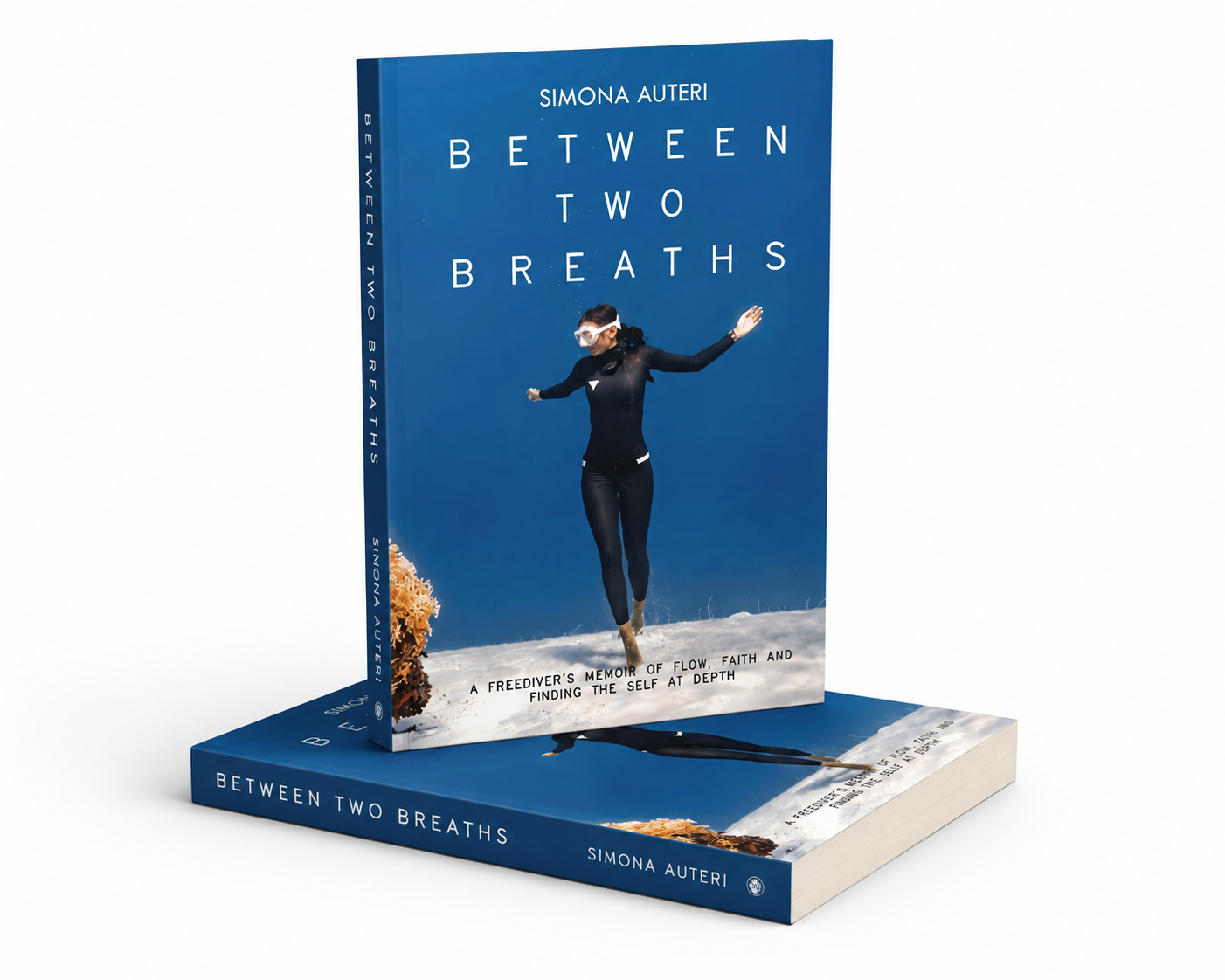
Order an author signed copy of Between Two Breaths!
Somewhere between effort and surrender, there is a place where breath becomes stillness.
Between Two Breaths tells the story of how a chance encounter with the underwater world transformed architect and entrepreneur Simona Auteri into a world-record freediver. Beneath the surface, where pressure rises and silence deepens, she learns how fear can become focus, and how letting go can reveal a new kind of strength.
Part personal journey and part love letter to water, the book explores the physical and mental demands of freediving, the power of breath, and the clarity found in surrendering to the unknown. In a world shaped by speed and noise, freediving becomes a practice of return - to presence, to trust and to what remains when everything unnecessary falls away.
Simona Auteri is a world-record freediver, multiple-time Italian champion, and recipient of several sporting merit awards from the Italian Olympic Committee (CONI). She coaches breathwork and mental performance techniques.