
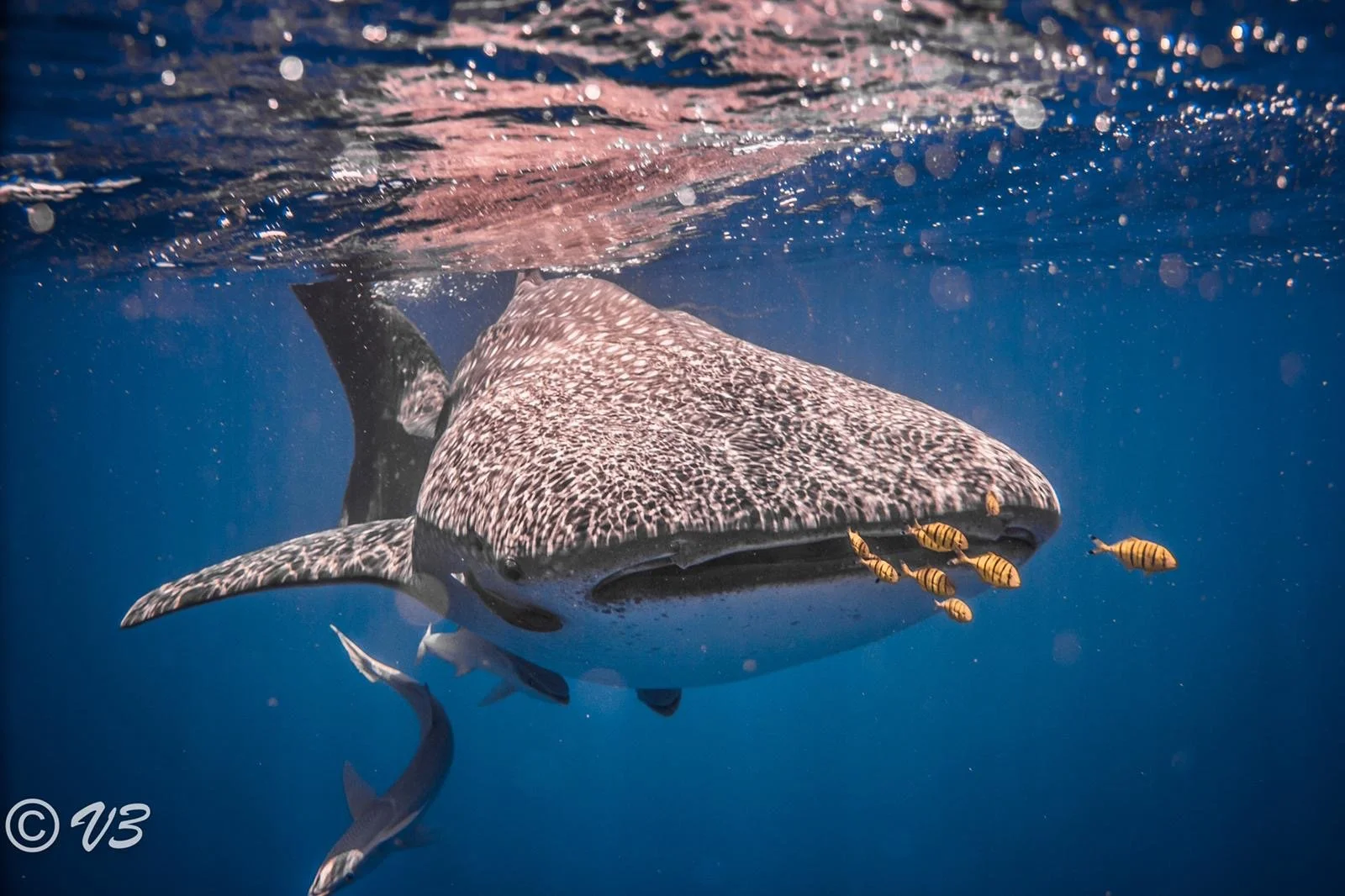
Beyond Performance: What Swimming with Whale Sharks Taught Me About Purpose
How a scientific conservation project in Madagascar transformed my relationship with freediving, the ocean and the meaning of human potential.
Photo Vincent Bourdin
One morning in November 2019, off the coast of Madagascar, I noticed something unusual in the blue.
A whale shark was struggling with a thick rope wrapped tightly around its body. Beneath it were deep wounds.
It was heartbreaking to witness such a magnificent creature suffering because of something left behind by humans.
Until that moment, freediving had largely been a journey of personal discovery. But that morning, it became something else entirely.
A book that opened a door
In 2019, a friend recommended that I read Deep by James Nestor.
As I turned its pages, I found myself increasingly drawn to the aquatic world, not simply as a sporting environment, but as a place of profound connection with life itself.
The book opened doors to entirely new perspectives and introduced me to conservation and scientific research projects around the world.
In November that year, I decided to volunteer with the Madagascar Whale Shark Project.
It was a leap into the unknown, driven by a desire to reconnect with the ocean in a different way.
The warm, crystalline waters of Madagascar were the opposite of my frantic urban existence in London. Here, the sea was not simply somewhere to dive. It was a living ecosystem, full of mysteries and connections waiting to be discovered.
When freediving becomes a scientific tool
Founded in 2016 by Belgian biologist and conservationist Stella Diamant, the Madagascar Whale Shark Project brings together researchers, local communities, tourism operators and volunteers to study and protect whale sharks around Nosy Be.
Its work involves scientific research, education and the development of responsible ecotourism.
The underlying idea is both simple and powerful: protecting marine life can create lasting value for local communities.
Whale sharks are the largest living fish on our planet. Despite their extraordinary size, they feed primarily by filtering small organisms from the water. Much about their behaviour, movements and life cycle remains to be discovered.
They are also classified as an endangered species.
Our work as volunteers involved collaborating with the local sustainable tourism operator Les Baleines Rand’Eau to identify and document individual whale sharks.
Every whale shark has a unique pattern of white spots, a natural constellation as distinctive as a human fingerprint.
We photographed the markings on the left side of each animal, recorded its GPS location and contributed the information to WhaleShark.org, a global identification database that helps researchers understand the movements and behaviour of these extraordinary animals.
During the 2019 season, the project documented 413 photographically identified whale shark encounters across 97 days of marine surveys.
For the first time, my ability to move comfortably underwater was serving a purpose beyond my own development.
Every photograph, every observation and every encounter became a small contribution to a much larger body of knowledge.
Discovering the intelligence of the ocean
The waters around Nosy Be are home to far more than whale sharks.
The abundance of plankton attracts extraordinary marine megafauna. I experienced a profound sense of peace swimming alongside groups of mobula rays, encountering curious dolphins and observing sea turtles as they fed.
The region is also home to a remarkable population of Omura's whales, a poorly understood species studied off the coast of Madagascar by marine biologist Dr Salvatore Cerchio and his team since 2013.
During my stay, I had the privilege of meeting him while he was conducting acoustic research.
He played us recordings captured by underwater hydrophones. We could distinguish individual calls and overlapping choruses, reminiscent of the sounds of birds or insects.
An entire world of communication was unfolding beneath the surface, largely inaccessible to our ordinary human senses.
As an architect, I had spent years observing relationships between spaces, materials, people and environments.
In Madagascar, I found myself observing relationships of an entirely different kind: those between living organisms, their habitats and the intricate systems that sustain them.
The more I learned, the more I realised how little I knew.
The whale shark with the rope
Then came the encounter that would stay with me long after I left Madagascar.
From a distance, I noticed a whale shark struggling with a large rope wrapped tightly around its body.
I alerted Thomas, an experienced freediver and guide from Les Baleines Rand’Eau.
Together, we managed to release the animal from the rope. It took three dives.
What remains most vivid in my memory is the extraordinary physical presence of the shark, the wounds beneath the rope and the emotional intensity of witnessing such vulnerability in an animal of that size.
The following day, remarkably, we encountered it again. It was swimming freely.
I cannot know what the animal experienced, nor whether the apparent moments of cooperation were anything more than coincidence. But for me, the encounter changed something fundamental.
Freediving was no longer simply about what I could achieve.
It was also about what I could contribute.
Looking back, I also recognise the risks involved in that encounter. Approaching and attempting to disentangle large marine animals can be extremely dangerous for both the animal and the people involved. Such situations should be reported to local conservation teams or appropriately trained responders rather than attempted independently.
From achievement to contribution
We spend much of our lives thinking about what we want to achieve.
We pursue qualifications, professional milestones, sporting goals and personal ambitions. We measure progress through numbers, results and increasingly demanding objectives.
There is nothing inherently wrong with ambition. It can provide direction, motivation and a sense of accomplishment.
But there is another dimension of human potential that is perhaps less frequently discussed.
What happens when the capabilities we develop are used in the service of something greater than ourselves?
In Madagascar, my freediving skills allowed me to participate in scientific research, observe marine life with minimal disturbance and contribute to an international conservation initiative.
The skills themselves had not changed. Their purpose had.
And that change in purpose transformed my experience of using them.
This was before I became a competitive freediver, before the world championships, before the records.
In many ways, Madagascar laid the foundations for my understanding of what freediving could mean beyond sport.
Connection as a catalyst for change
Environmental awareness often begins with information. We learn about endangered species, habitat destruction, pollution and the consequences of human activity.
But knowledge alone does not always generate an emotional connection.
Experiencing something directly can change our relationship with it.
It is difficult to remain indifferent to the vulnerability of marine life when you have looked into the eyes of an animal affected by human activity.
This is why I believe that experiential learning, responsible ecotourism and citizen science can play such an important role in conservation.
They create opportunities not only to understand the natural world, but to develop a personal relationship with it.
That relationship can become a powerful source of motivation.
Perhaps the question is not simply how we can encourage people to care more about the environment, but how we can create opportunities for them to experience a genuine connection with it.
Bringing these lessons beyond the ocean
Today, as an architect, world-record freediver, author and speaker, I explore the relationship between human potential, personal transformation and our connection with the world around us.
Through my keynotes and conferences, I bring stories from the depths of the ocean into conversations about:
Purpose and meaningful performance
Environmental responsibility and our relationship with nature
Adaptability, curiosity and experiential learning
The connection between individual capabilities and collective impact
Through my experiential workshop, 5 Minutes to Flow — How Breath Changes Everything, I also invite participants to rediscover something fundamental: their connection with their own bodies, through the breath.
I believe that meaningful change often begins with experience. Whether we are exploring our internal world or the natural environment around us, connection can transform the way we think, feel and act.
If you are organising a conference, sustainability event, corporate retreat or team development experience, get in touch to discuss speaking engagements and workshops.
I also welcome collaborations with organisations, conservation initiatives and brands committed to protecting our oceans and promoting a more conscious relationship with the natural world.
Discover Between Two Breaths
My journey into freediving has never been exclusively about depth.
It has been about discovering different ways of inhabiting the world, questioning my assumptions and exploring the relationship between performance, identity, connection and meaning.
I share this journey in my memoir, Between Two Breaths — A Freediver's Memoir of Flow, Faith, and Finding the Self at Depth.
Discover Between Two Breaths and explore the story beyond the sporting achievements.
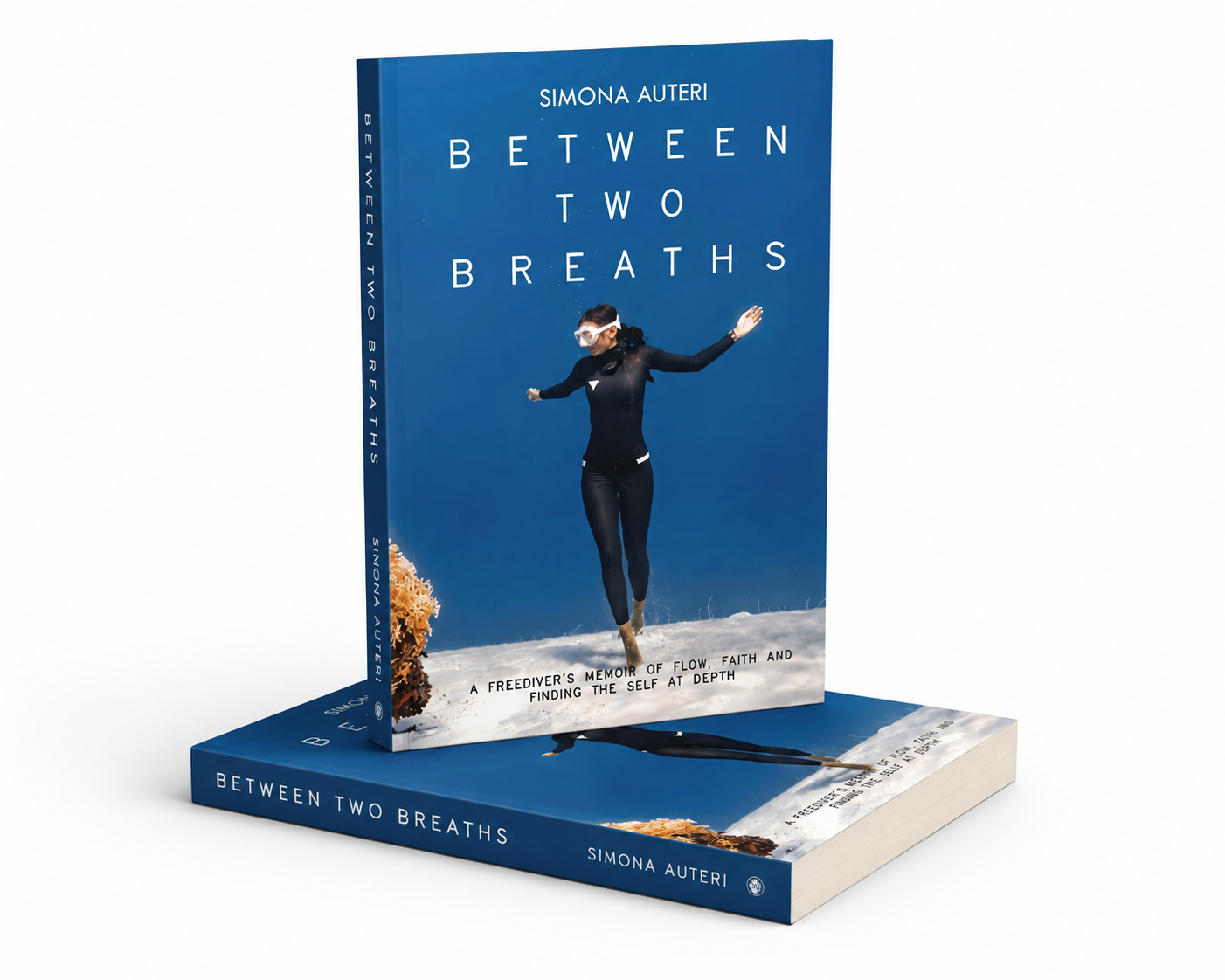
Order an author signed copy of Between Two Breaths!
Somewhere between effort and surrender, there is a place where breath becomes stillness.
Between Two Breaths tells the story of how a chance encounter with the underwater world transformed architect and entrepreneur Simona Auteri into a world-record freediver. Beneath the surface, where pressure rises and silence deepens, she learns how fear can become focus, and how letting go can reveal a new kind of strength.
Part personal journey and part love letter to water, the book explores the physical and mental demands of freediving, the power of breath, and the clarity found in surrendering to the unknown. In a world shaped by speed and noise, freediving becomes a practice of return - to presence, to trust and to what remains when everything unnecessary falls away.
Simona Auteri is a world-record freediver, multiple-time Italian champion, and recipient of several sporting merit awards from the Italian Olympic Committee (CONI). She coaches breathwork and mental performance techniques.
Support whale shark conservation
To learn more about the research, education and conservation initiatives taking place in Madagascar, visit the Madagascar Whale Shark Project.
You can also explore the global whale shark identification database at WhaleShark.org and discover the acoustic and behavioural research of The Omura's Whale Project.
With thanks to Stella Diamant, Dr Simon J. Pierce, the Madagascar Whale Shark Project and the team at Les Baleines Rand’Eau.