
The Architect of the Mind: How Our Environment Shapes Who We Become
What a summer of freediving in Nice taught me about collective excellence, human potential and the invisible influence of our surroundings.
There are moments in life that leave a permanent mark. A path opens before us in the fog, and we follow it with very little awareness of the extraordinary things that await us.
For me, 2020 was precisely that.
The long London lockdown brought to the surface a desire I had ignored for too long: I wanted a simpler life, closer to nature, with more space for exploration and discovery.
Freediving was no longer simply calling me. It was pulling me towards something.
With my architectural work now entirely remote, I decided to follow that intuition. I bought a second-hand car, found a small apartment behind the port of Nice and left London.
I knew nobody, spoke barely a word of French and had no particular plans beyond training. But I had something else: trust in my intuition and a promise I had made to myself to follow my passion.
Stepping into a different world
I knew where I wanted to go.
The CIPA — Centre International de Plongée en Apnée — was a name I had encountered countless times in documentaries, articles and freediving videos. Some of the world's greatest freedivers trained there.
But experiencing it first-hand was something else entirely.
Suddenly, the people I had previously watched through a screen were sitting next to me on a boat: Guillaume Néry, Arnauld Jerald, Alice Modolo, Guillaume Bourdila, Walid Boudiaf and Arthur Guérin-Boëri.
My equipment was remarkably modest: a 5mm spearfishing wetsuit and a pair of fins with foot pockets that were too large for me.
I had no coach, no structured training programme and very little understanding of what I might eventually be capable of.
Yet I had unknowingly placed myself in an environment that would fundamentally alter my perception of human potential.
A living culture of excellence
CIPA was more than a freediving club. It was a place filled with history, energy and soul, with roots reaching into the very origins of modern freediving.
Its founder, Loïc Leferme, was a visionary whose relationship with the sea was deeply spiritual. Depth, for him, was not simply somewhere to conquer, but somewhere to belong. Freediving was as much about presence and connection as it was about performance.
That philosophy continued to permeate the club.
At the heart of our mornings was Cédric Palerme: a storyteller, a scientist, a joker and a living encyclopaedia of the Mediterranean.
Every morning, we gathered at the harbour before boarding La Blonde, our little yellow boat named in memory of Loïc. As we made our way towards the bay of Villefranche-sur-Mer, Cédric would entertain us with stories about marine life, the history of freediving and the extraordinary creatures inhabiting the waters beneath us.
There was something remarkable about the coexistence of excellence and simplicity. World champions and curious beginners shared the same boat, the same water and the same enthusiasm for discovery.
Excellence was not something distant or abstract. It was part of everyday life.
And without realising it, I was absorbing it.
Learning through osmosis
As an architect, I had spent years studying how physical environments influence human behaviour.
The proportions of a room, the quality of light, the relationship between spaces, the way people move through a building — all these elements influence how we feel, interact and experience the world.
Through freediving, I began to understand how profoundly our social environments can influence us too.
Without a coach or a prescribed training programme, I learned through observation. I watched how experienced freedivers prepared for their dives, how they breathed, how they moved, how they approached depth and how they recovered.
Through curiosity, attention and humility, I was learning by osmosis.
In three weeks, I went from diving 35 metres to 52 metres.
But the most significant transformation was not measured in metres. It was happening in my perception of what was possible.
Watching someone return from a depth of 110 metres, something I witnessed more than once that summer, completely overturned my understanding of human capabilities.
What had previously seemed almost unimaginable gradually became conceivable. And eventually, something I could aspire to myself.
When our perception of possibility changes, so does our perception of who we can become.
The invisible architecture of our minds
We tend to think of our limitations as something intrinsic to us. We define ourselves through our abilities, our experiences, our achievements and our failures.
But how much of what we believe about ourselves is actually a reflection of the environments in which we have lived?
The people around us, the conversations we have, the behaviours we observe and the things we repeatedly experience all contribute to the construction of our internal world.
Our surroundings provide us with reference points. They influence what we consider normal, extraordinary, achievable or impossible.
Before arriving in Nice, my perception of depth was shaped by my own relatively limited experience. Once I entered an environment where extraordinary performances were part of everyday life, that frame of reference began to expand.
My body had not suddenly become a different body. But my understanding of what it might be capable of had changed.
This is one of the most fascinating parallels I have discovered between architecture and freediving.
As architects, we design physical spaces that can influence the way people behave. But throughout our lives, we are also constructing an invisible architecture: the mental structures through which we interpret ourselves and the world around us.
And these structures are not necessarily permanent. They can evolve through attention, experience, learning and exposure to new possibilities.
What kind of environment are we creating?
These observations extend far beyond sport.
Within companies, teams and organisations, culture plays a fundamental role in shaping individual performance. The behaviours that are modelled, the questions that are encouraged, the mistakes that are tolerated and the possibilities that are collectively imagined all influence how individuals develop.
An environment driven by fear and judgement may discourage experimentation. An environment that encourages curiosity, trust and the sharing of knowledge can create opportunities for discovery and growth.
What I experienced at CIPA was not simply the influence of exceptionally talented individuals. It was the power of a collective culture in which knowledge was shared, excellence was visible and learning was embedded in everyday experience.
The question, then, is not simply how we can become better performers as individuals.
It is also how we can create environments in which people discover capabilities they did not previously know they possessed.
What behaviours are we modelling for those around us?
Are we creating environments that encourage curiosity or conformity?
Are we exposing ourselves and our teams to different ways of thinking?
How much of our potential remains unexplored because our environment has never challenged our perception of what is possible?
More than depth
I didn't know it at the time, but that summer would become one of the foundations of my international freediving career.
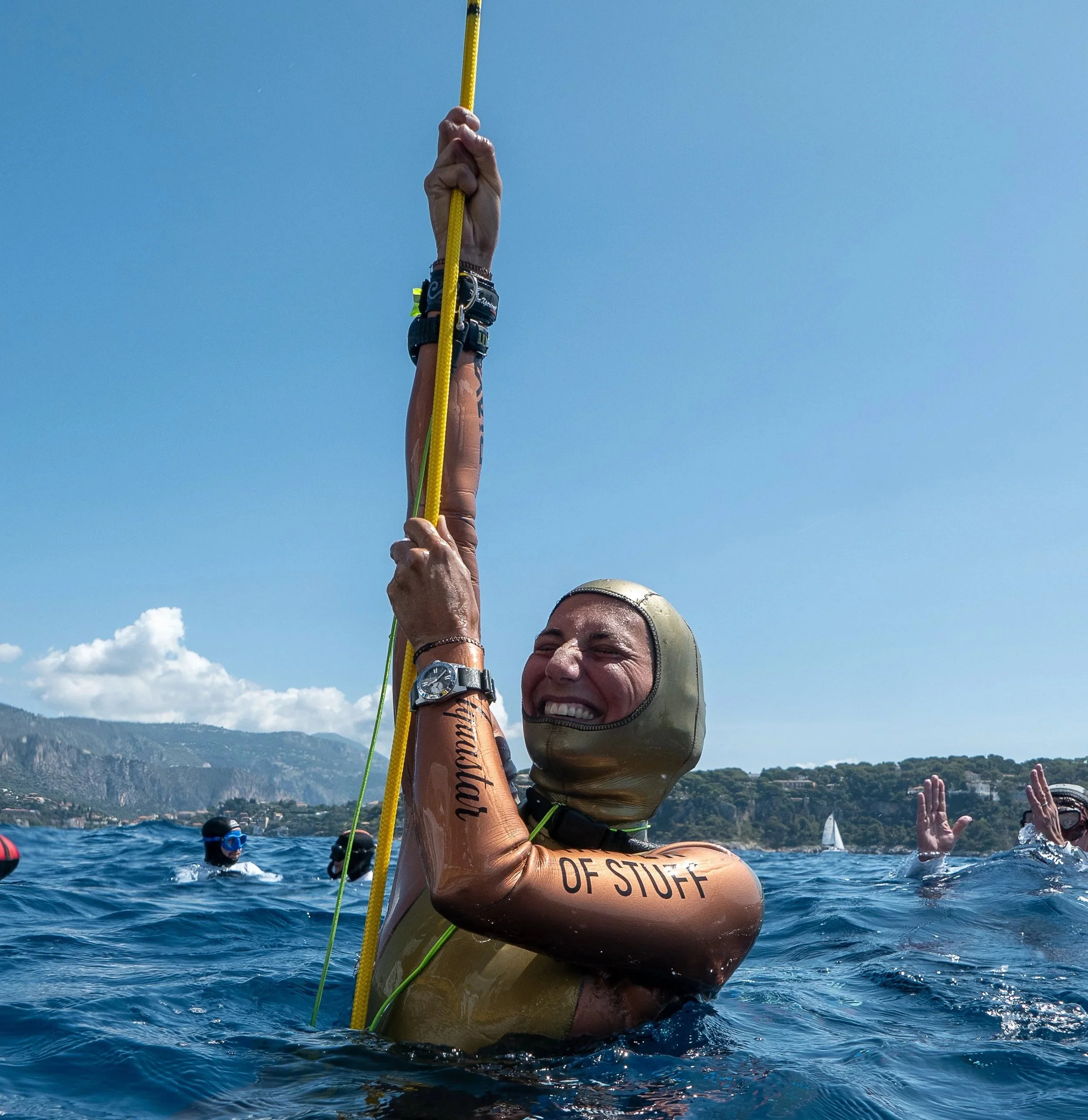
In the years that followed, I would represent Italy at World Championships and establish world records. Yet the journey began on a little yellow boat in the Mediterranean, wearing a spearfishing wetsuit and a pair of oversized fins.
Nice gave me more than depth. It gave me a compass.
And today, six years later, it is the place I call home.
Bring these lessons to your organisation
Today, I bring the lessons learned through architecture, world-record freediving and personal reinvention to companies, organisations and international audiences.
Drawing on my experience in two seemingly different worlds, I explore how we can reshape our mental frameworks, adapt to unfamiliar environments, navigate pressure and expand our perception of human potential.
Keynotes and conferences
My talks explore the intersection of architecture, freediving and the human mind, addressing themes such as:
Human potential and the perception of possibility
Adaptability and personal reinvention
Creativity and the architecture of the mind
Collective excellence and performance culture
Mental performance and our relationship with fear and pressure
5 Minutes to Flow — How Breath Changes Everything
An experiential workshop that brings the lessons of freediving into everyday professional life.
Through accessible breathing exercises and an exploration of the relationship between mind and body, participants discover practical tools to manage stress, regulate their physiological state, improve focus and create conditions conducive to flow.
The workshop is designed for leadership teams, corporate events, conferences and organisations interested in human performance, wellbeing and sustainable excellence.
Are you looking for a different perspective at your next conference, leadership event or team development day?
Get in touch to discuss speaking engagements, keynotes and experiential workshops tailored to your organisation.
Discover Between Two Breaths
The summer I spent in Nice was the beginning of a much larger journey — one that took me from architecture to competitive freediving, from the pursuit of depth to a deeper exploration of identity, fear, trust and human potential.
I explore this journey in my memoir, Between Two Breaths — A Freediver's Memoir of Flow, Faith, and Finding the Self at Depth.
Beyond the sporting achievements, it is a reflection on how we become who we are, how we learn to question our perceived limitations and what happens when we allow ourselves to explore the unknown.
Discover Between Two Breaths and explore the full journey.
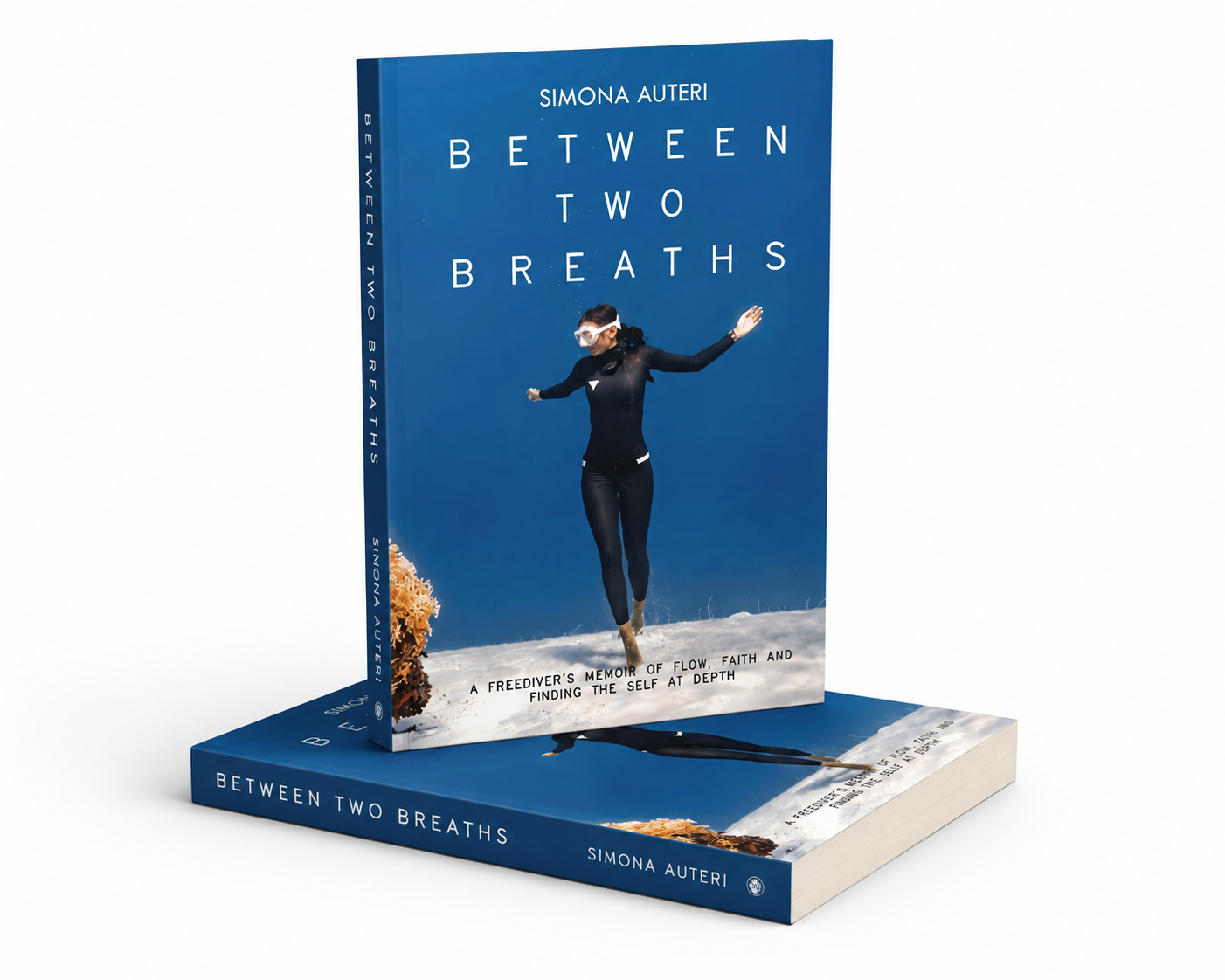
Order an author signed copy of Between Two Breaths!
Somewhere between effort and surrender, there is a place where breath becomes stillness.
Between Two Breaths tells the story of how a chance encounter with the underwater world transformed architect and entrepreneur Simona Auteri into a world-record freediver. Beneath the surface, where pressure rises and silence deepens, she learns how fear can become focus, and how letting go can reveal a new kind of strength.
Part personal journey and part love letter to water, the book explores the physical and mental demands of freediving, the power of breath, and the clarity found in surrendering to the unknown. In a world shaped by speed and noise, freediving becomes a practice of return - to presence, to trust and to what remains when everything unnecessary falls away.
Simona Auteri is a world-record freediver, multiple-time Italian champion, and recipient of several sporting merit awards from the Italian Olympic Committee (CONI). She coaches breathwork and mental performance techniques.