
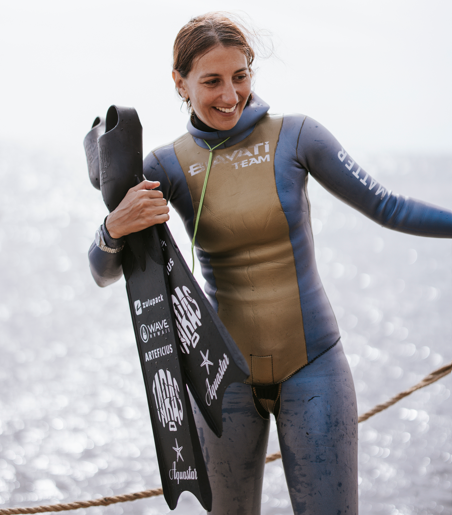
Becoming an Athlete: The Architecture of Identity
On impostor syndrome, professional reinvention and giving ourselves permission to become someone new.
For much of my adult life, I had a clear and reassuring script.
Whenever someone asked me what I did, the answer came without hesitation.
"I'm an architect."
Or, later, "I run a design consultancy."
The words came naturally. They were solid, recognisable and socially understood. They defined not only a profession, but a position in the world. They were titles that gave structure to my days, made people nod in recognition and, above all, made me feel that I belonged.
That I was legitimate.
Those roles had clearly defined contours: business cards, LinkedIn profiles, strategic calls and Excel spreadsheets.
They were anchors. And like all anchors, they held in place a boat that, over time, had begun to feel the pull of the open sea.
When a passion becomes an identity
As freediving began to occupy more and more space in my life — first in my calendar, then in my thoughts, and eventually in the very rhythm of my days — something began to loosen.
Initially, slowly and almost imperceptibly. Then irreversibly.
I continued working, answering emails and managing clients across different time zones. But between meetings, I would slip into a wetsuit, study physiology, analyse my body's responses and spend hours training in the sea.
What I had always described as a passion was changing its nature.
It was no longer a parallel interest, a counterbalance to my "real" life. It was becoming a choice, a direction, something I could no longer reduce to the word hobby.
And yet, I still couldn't say it out loud.
"I'm a freediver."
"I'm an athlete."
The words remained suspended, as though they didn't quite belong to me. I tried them on in silence, with the same caution with which one might try on a beautiful but rather daring piece of clothing, wondering whether it was really made for them.
The words didn't feel false. They felt premature.
As though someone, sooner or later, would expose me as an impostor.
The invisible rules of belonging
The impostor within me had some rather convincing arguments.
I had arrived late. I had discovered freediving as an adult. I already had a life and a career built elsewhere.
Real athletes, I told myself, were something different.
They had different bodies, different stories and a past that I didn't have.
Without realising it, I had constructed a series of conditions that I believed needed to be fulfilled before I could legitimately call myself an athlete.
Nobody had imposed those conditions on me.
They were structures I had built myself, through years of cultural expectations, comparisons and assumptions about what an athlete should look like and how an athletic career should begin.
As an architect, I find this particularly interesting.
We spend our lives constructing mental frameworks through which we interpret the world. These frameworks help us navigate reality, but they can also become invisible boundaries.
Sometimes, the structures that once gave us security become the very things that prevent us from recognising our own evolution.
The water doesn't ask for credentials
And then there was the water.
The water makes no concessions, but neither does it judge.
In the sea, it doesn't matter who you used to be, what career you have built or how credible you appear on paper.
What matters is presence, honesty and the ability to listen.
Everything else dissolves, quite literally, with depth.
During my first months in Dahab, Egypt, I found more than a place to train. I discovered a life that felt surprisingly whole.
A life grounded in physicality and a mental clarity that seemed to emerge after hours spent in the water.
My relationship with my body was changing. My priorities were changing. And with them, my sense of direction.
I realised that I didn't want to return to my previous life in London — to the asphalt, the long days spent indoors, illuminated by screens.
Not because that life had been wrong, but because it no longer felt like mine.
The real transformation, however, wasn't external.
It was happening in the way I saw myself.
The moment someone called me an athlete
After my first freediving competition at the Blue Hole in Dahab, in the spring of 2021, someone casually referred to me as "the athlete".
Instinctively, I turned around, convinced they were talking about somebody else.
Somebody with a different body, sculpted abdominal muscles and an appearance more consistent with the image I had always associated with that word.
But they were talking about me.
At first, it made me smile, as though the word didn't quite belong to me.
Then it gradually began to settle, as things sometimes do when we recognise them first in the body and only later in the mind.
The word wasn't changing what I did.
It was making visible a transformation that had already taken place.
The people around me had recognised it before I had.
They had never asked whether I had earned the right to call myself an athlete. They had simply included me.
And little by little, I began to believe it too.
When identity lags behind experience
I often wonder how many of us experience something similar.
We acquire new skills, take on new responsibilities, develop new interests or make significant changes in our lives. Yet our internal image of who we are remains anchored to an earlier version of ourselves.
The professional who becomes an entrepreneur but still feels uncomfortable calling themselves one.
The creative person who produces work for years but hesitates to call themselves an artist.
The newly appointed leader who continues to question whether they deserve their position.
The person who discovers an entirely new passion in their thirties, forties or fifties but believes it is too late to take it seriously.
Our experience evolves, but our identity doesn't always evolve at the same pace.
Perhaps this is one of the reasons why reinvention can feel so uncomfortable. It requires more than learning new skills or changing our circumstances. It requires questioning the mental structures through which we recognise ourselves.
And sometimes, it requires giving ourselves permission to inhabit an identity before we feel entirely comfortable within it.
Reinvention is not necessarily replacement
For a long time, I thought that becoming an athlete meant moving away from being an architect.
Today, I see things differently.
Architecture taught me observation, conceptual thinking, creativity, discipline and the ability to navigate complex processes.
Freediving taught me embodiment, attention, trust, adaptability and a different relationship with uncertainty.
These two identities are not in opposition. They inform and enrich one another.
The architect influences the way I approach freediving. The athlete influences the way I understand design, performance and human behaviour.
And both have shaped the writer and speaker I am becoming today.
Perhaps reinvention is not always about abandoning who we were.
Perhaps it is about expanding our understanding of who we are allowed to become.
The role of belonging
Looking back, I also recognise the importance of the community that surrounded me during those early years.
Being accepted by other athletes helped me recognise something that I was struggling to recognise within myself.
There is an important lesson here for organisations, leaders and teams.
The way we recognise the potential of others can influence the way they perceive their own capabilities. Sometimes, being seen differently by someone else allows us to begin seeing ourselves differently.
An environment in which people feel trusted, included and encouraged to explore unfamiliar roles can create opportunities for growth that extend far beyond technical learning.
How often do we continue to define people by what they have done in the past, rather than recognising what they are becoming?
And how often do we do exactly the same thing to ourselves?
Becoming
Saying "I am a freediver, I am an athlete" was not an escape, but a structure.
It was not chaos, but a choice.
It was the most honest way I had found to describe a life that revolved around the sea, attention, discipline and a community grounded in a shared passion.
In the years that followed, I would represent Italy at World Championships and establish world records.
But becoming an athlete had begun long before those achievements.
Today, the word no longer surprises me.
And every time I stand on the competition platform, still and silent, preparing to enter the water, I know that I am exactly where I need to be.
I am a freediver.
I am an athlete.
And I am still becoming.
Bringing these lessons to companies and organisations
Today, I bring the lessons learned through architecture, world-record freediving and personal reinvention to companies, leadership teams and international audiences.
My keynotes and conferences explore the invisible mental structures that shape our identity, influence our performance and sometimes limit our perception of what we can become.
Drawing on my own experiences of navigating professional change and competing at an international level, I address themes including:
Professional reinvention and identity
Impostor syndrome and perceived limitations
Adaptability and navigating uncertainty
Belonging and cultures of growth
Mental performance, fear and self-trust
Human potential beyond conventional definitions of success
Through my experiential workshop, 5 Minutes to Flow — How Breath Changes Everything, I also introduce participants to the relationship between mind and body, offering practical breathing exercises that can support stress regulation, focus and performance under pressure.
My approach combines personal storytelling, insights from architecture and elite sport, and experiential learning.
If you are organising a conference, leadership event, professional development programme or corporate retreat, I would love to hear from you.
Get in touch to discuss keynotes, speaking engagements and experiential workshops for your organisation.
Discover Between Two Breaths
The question of identity lies at the heart of my memoir, Between Two Breaths — A Freediver's Memoir of Flow, Faith, and Finding the Self at Depth.
It tells the story of my journey from architecture to competitive freediving, but more importantly, it explores what happens in the spaces between identities.
Between the person we have been and the person we are becoming.
Between the security of the familiar and the possibilities of the unknown.
Between the life we have carefully constructed and the life we are only beginning to imagine.
If you have ever questioned whether it is too late to pursue a different path, whether you belong somewhere unfamiliar, or whether you are allowed to become someone other than the person you have always been, perhaps something in this story will resonate with you.
Discover Between Two Breaths and explore the full journey.
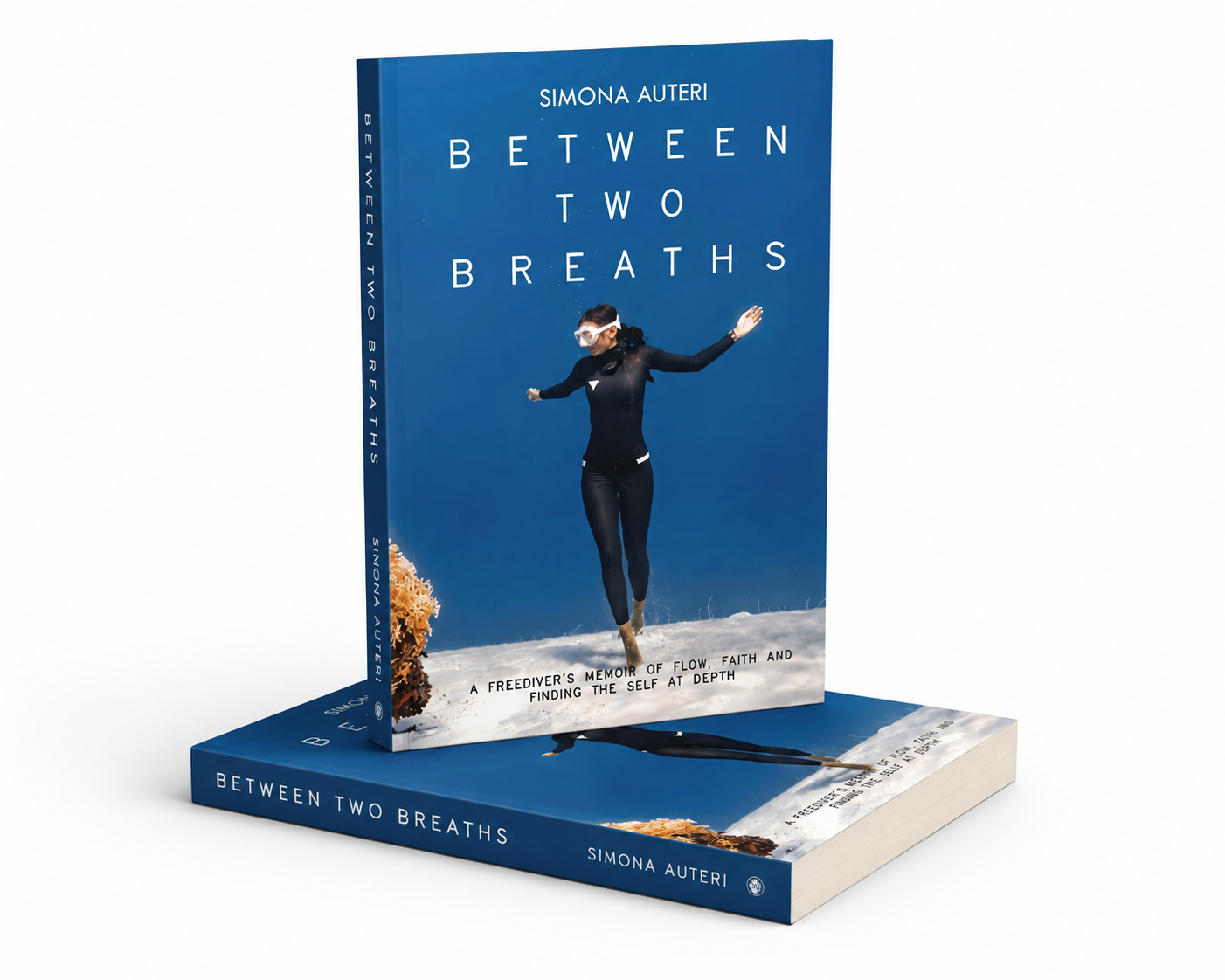
Order an author signed copy of Between Two Breaths!
Somewhere between effort and surrender, there is a place where breath becomes stillness.
Between Two Breaths tells the story of how a chance encounter with the underwater world transformed architect and entrepreneur Simona Auteri into a world-record freediver. Beneath the surface, where pressure rises and silence deepens, she learns how fear can become focus, and how letting go can reveal a new kind of strength.
Part personal journey and part love letter to water, the book explores the physical and mental demands of freediving, the power of breath, and the clarity found in surrendering to the unknown. In a world shaped by speed and noise, freediving becomes a practice of return - to presence, to trust and to what remains when everything unnecessary falls away.
Simona Auteri is a world-record freediver, multiple-time Italian champion, and recipient of several sporting merit awards from the Italian Olympic Committee (CONI). She coaches breathwork and mental performance techniques.