
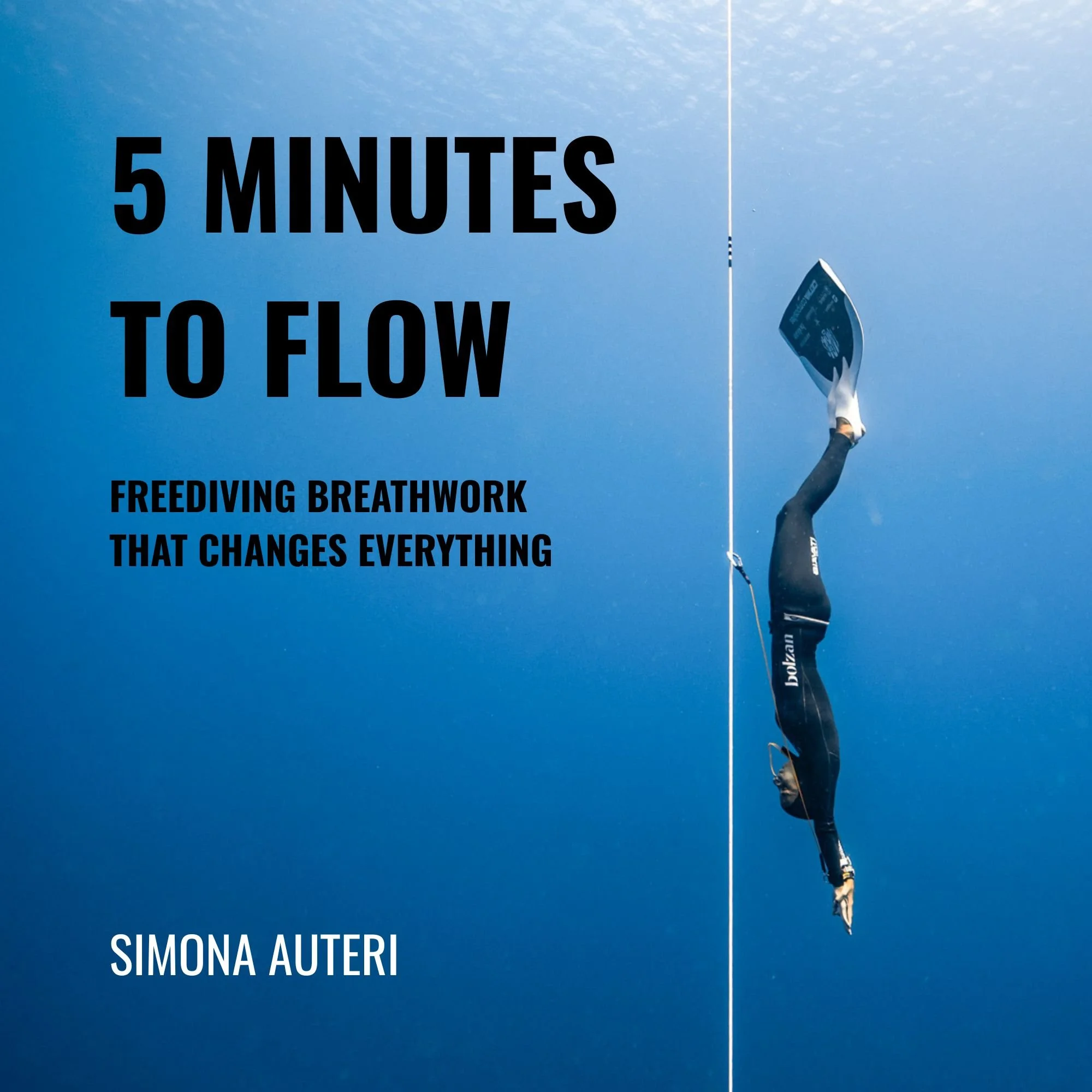
5 Minutes to Flow: From the Depths of the Ocean to the Corporate World
How competitive freediving inspired a methodology for navigating pressure, regulating stress and creating the conditions for optimal performance.
Freediving taught me something I wasn't looking for when I first began training in depth.
Something that had little to do with performance, metres or the numbers that inevitably become external measures of progress. It had much more to do with the way we inhabit ourselves, moment by moment.
Over time, I discovered that our internal state is not fixed. It is a dynamic system, constantly changing in response to our experiences, our environment and our physiology.
And we can learn to influence it through tools much simpler and more accessible than we might imagine.
The first of these is the breath.
Calm is not simply a personality trait
For a long time, I thought of calm as something almost accidental. Something that either arrived or didn't, depending on the circumstances, the environment or the particular day.
Freediving gradually dismantled that assumption.
Before a deep dive, everything becomes direct, essential and non-negotiable. I cannot simply tell myself to relax or expect my body to respond well to pressure because I have intellectually decided that I am ready.
I need to work with my physiology.
Over the years, I began to see breathing not simply as an automatic biological process, but as a language between the body and the nervous system.
Our breathing patterns both reflect and influence our internal state. What fascinates me is that we have access to this relationship at any moment, often without realising it.
I began to think of breath as a form of biological technology — something intrinsic to us, through which we can consciously interact with processes that are otherwise largely automatic.
Creating the conditions for flow
The psychologist Mihaly Csikszentmihalyi described flow as a state of deep absorption in an activity, in which action and awareness merge, our perception of time changes and self-consciousness diminishes.
Athletes call it being "in the zone". Artists, musicians, architects and writers experience it when they become completely immersed in a creative process.
In freediving, this condition takes on a particularly silent quality.
I have experienced dives that were perfect on paper but felt heavy and fragmented, and others that, despite more challenging circumstances, became extraordinarily fluid experiences.
Sometimes, the most significant difference was not the environment, but the internal state in which I arrived at the moment of the dive.
Flow cannot be guaranteed or summoned on demand. But we can learn to recognise and prepare some of the conditions that make it more likely to emerge.
From control to regulation
I remember a period in my training when I tried to control everything: my breathing, my heartbeat, my mental preparation, the descent itself.
Yet the more I tried to impose control, the more rigid my body became and the further I moved away from the fluidity I was seeking.
As an architect, I had spent years designing structures, organising complex systems and finding solutions to problems.
Freediving introduced me to a different approach. Rather than imposing a solution, I needed to observe the existing conditions, understand them and learn to work with them.
I was discovering the difference between control and regulation.
This distinction gradually became one of the foundations of my work.
The birth of 5 Minutes to Flow
Drawing on years of competitive freediving, international competitions and personal exploration, I developed a methodology that I call 5 Minutes to Flow — How Breath Changes Everything.
The underlying principle is simple: even a few minutes of conscious breathing and attention can offer an opportunity to influence our internal state.
The methodology is structured around three complementary pillars:
Grounding — finding stability.
Activation — recovering energy and clarity.
Balancing — integrating breath, body and attention.
Rather than offering a single breathing technique as a universal solution, the method encourages participants to develop greater awareness of their internal state and explore practical ways of responding to it.
Its simplicity is deliberate. In moments of pressure, we need tools that are accessible, intuitive and easy to integrate into everyday life.
Beyond freediving
Perhaps my most important discovery was that these lessons did not remain confined to the underwater world.
The relationship between breathing, attention and our experience of pressure is present throughout our lives.
Before an important meeting. Before stepping onto a stage. During a difficult conversation. In the middle of an overwhelming working day.
We cannot always change our external circumstances, but we can sometimes influence the internal state through which we experience them.
In March 2026, I brought this work to leaders through the NHS Thinking Through Academy in the United Kingdom.
In June 2026, I presented 5 Minutes to Flow at the Brain Health Summit at York University in Toronto, organised by Brain Changes Initiative.
These experiences reinforced my belief that some of the most valuable lessons from competitive sport are relevant far beyond athletic performance.
Bring 5 Minutes to Flow to your organisation
5 Minutes to Flow — How Breath Changes Everything is my signature experiential workshop, designed for companies, leadership teams, conferences and organisations interested in human performance and wellbeing.
Combining storytelling from the world of elite freediving, insights into the mind-body relationship and guided experiential exercises, the workshop invites participants to explore practical tools for:
Stress regulation and emotional awareness.
Focus and mental clarity.
Performance under pressure.
Developing a more conscious relationship with the body.
Creating conditions conducive to presence and flow.
No previous experience of breathwork, meditation or freediving is required.
Alongside the workshop, I offer keynotes and conferences exploring human potential, adaptability, reinvention and the architecture of the mind.
Are you looking to bring a different perspective on performance, leadership and wellbeing to your next event?
Get in touch to discuss bringing 5 Minutes to Flow to your company, conference or leadership team.
Between Two Breaths
The experiences that inspired this methodology are also at the heart of my memoir, Between Two Breaths — A Freediver's Memoir of Flow, Faith, and Finding the Self at Depth.
Freediving taught me that between fear and calm there can be a transition. Between confusion and clarity, a subtle adjustment. And sometimes, between tension and flow, a breath that changes quality.
We are never entirely fixed in one state. We are constantly in transition.
The breath does not control this movement, but it can help us participate in it.
Discover Between Two Breaths and explore the journey behind the methodology.
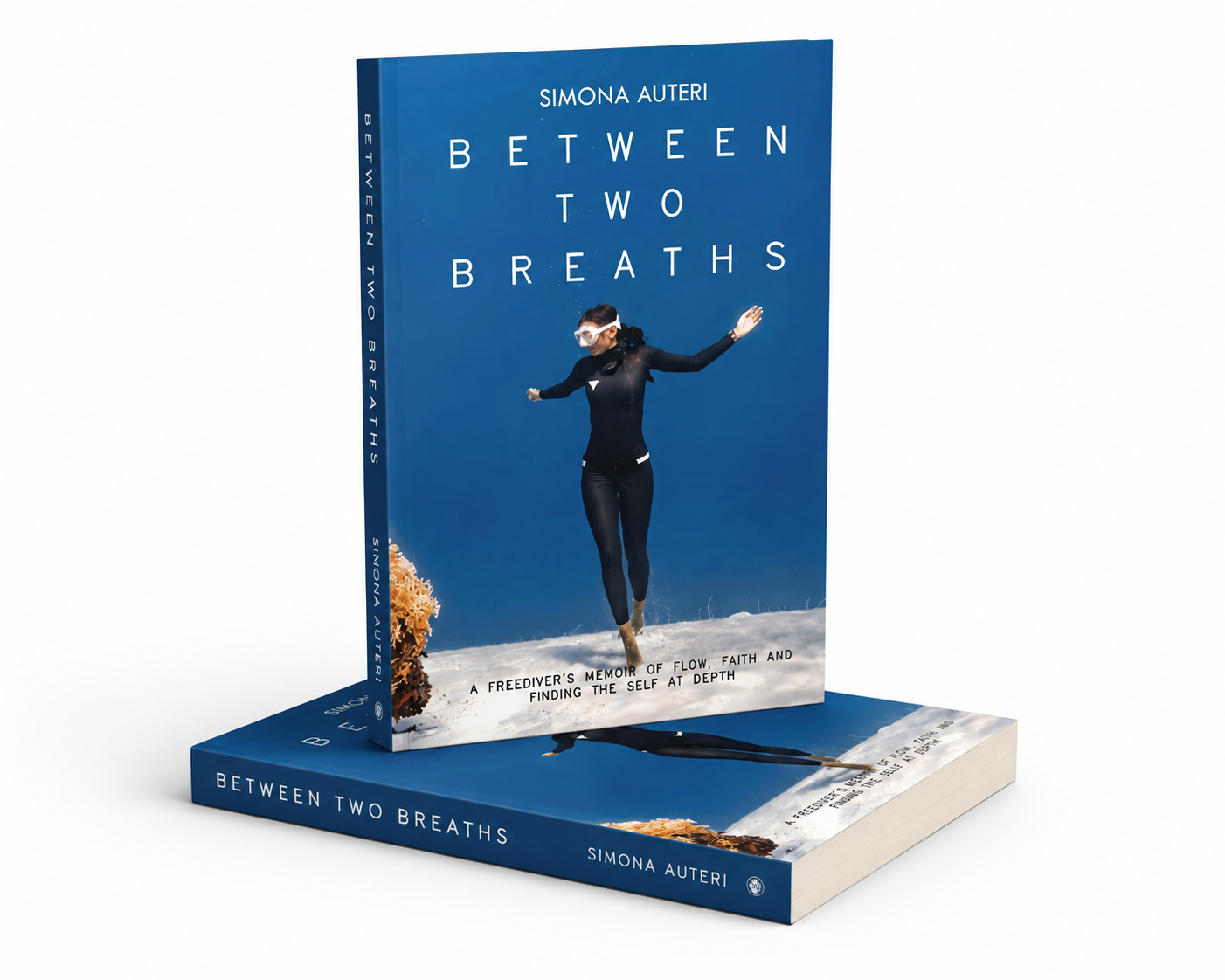
Order an author signed copy of Between Two Breaths!
Somewhere between effort and surrender, there is a place where breath becomes stillness.
Between Two Breaths tells the story of how a chance encounter with the underwater world transformed architect and entrepreneur Simona Auteri into a world-record freediver. Beneath the surface, where pressure rises and silence deepens, she learns how fear can become focus, and how letting go can reveal a new kind of strength.
Part personal journey and part love letter to water, the book explores the physical and mental demands of freediving, the power of breath, and the clarity found in surrendering to the unknown. In a world shaped by speed and noise, freediving becomes a practice of return - to presence, to trust and to what remains when everything unnecessary falls away.
Simona Auteri is a world-record freediver, multiple-time Italian champion, and recipient of several sporting merit awards from the Italian Olympic Committee (CONI). She coaches breathwork and mental performance techniques.