
Writing a Book Is an Act of Architecture in Miniature
by Simona Auteri
Writing a book shares much with architecture. In fact, I came to realise that writing Between Two Breaths was an architectural project in miniature.
In architecture school, they teach you not to think so much in terms of shapes, forms and colours, but rather to find a concept and then, once you have it, develop a process that makes it real.
It was the same for my book.
Between Two Breaths is as much literal as it is figurative. It's about what happens in the spaces in between. That can be the transition within a dive, when we leave our terrestrial form and start becoming something else entirely, almost an aquatic being. Or it can be in life, when we leave an identity behind to find a new one, when we are no longer quite who we used to be, but not yet who we are becoming.
That was the concept. And from there, I needed to find a way to make it real.
Materials
Then it's about materials.
In architecture, it's about brick, cement and glass, but it could also be cork, hemp, wood or wool. Each material has its own qualities, and the way you put them together determines what the final result will feel like.
For Between Two Breaths, the materials were easy to find. I had lots of them: notes on paper, daily journals written since 2016, Instagram posts, and email drafts never meant to be sent.
I started writing daily journals in 2016, after reading The Artist's Way by Julia Cameron. One of the ideas that stayed with me from that book was that it's never too late to start being an artist, and there's no better time to start than now.
So I started writing.
Sometimes it was journaling, but other times the best ideas came in the most random moments: on a plane, on a train - I've always loved those liminal spaces where you are suspended in space and time - but also in the middle of the night, at the gym, or in a shop.
I read somewhere that ideas don't really belong to us. They drift around in space, and then they come close to you. If you don't catch them at the right time, they simply go somewhere else.
And so I had to stop whatever I was doing.
If I was driving, I'd pull over somewhere safe. If I was at the gym, I'd sit on a bench press with my phone in hand, furiously typing away. To anyone looking at me, I probably appeared to be yet another person absorbed in her phone, but I wasn't doomscrolling. I was actually in the middle of an intense creative process.
And if I didn't write things down immediately, they were gone.
So the real challenge with writing my book wasn't finding enough material. It was organising it and giving it a structure.
Structure
And this brings me to the next element, which is structure.
In architecture, we need to find a coherent structure that allows a person to experience spaces and flow from one to another. A building isn't just a collection of rooms. There is a sequence, a logic to the way we move through it, and a relationship between the different spaces.
The book shared much of this.
Some chapters are denser, others lighter. Some are filled with emotions and leave the reader thinking, whilst others flow through and leave the reader hungry for more.
The narrative chapters, filled with travels and discoveries, are punctuated by interludes: more reflective moments where the reader is invited to pause and think, before moving on to the next part of the journey.
Just as in architecture, you need to understand where to pause, where to create tension, where to open up, and where to allow some breathing space.
Structure brings rhythm, and rhythm is what shapes our understanding of the world.
Music, architecture, books, birdsong — they all have rhythm.
And perhaps there is something particularly fitting about finding a rhythm in a book that is, ultimately, about breathing.
Visualisation: Memories from the Future
And then there is the visualisation part.
Freediving, and sports in general, share much of this aspect with architecture. We need to be creative, to imagine something before it happens, to see it in our minds before it becomes real.
In my book, I call visualisation "memories from the future."
I introduce the idea that time exists in our brains in a different form from reality. When we visualise something that may happen in the future, repeatedly and in great detail, we can create a sense of familiarity with an experience that hasn't happened yet, almost as though we were creating memories of it.
I have always been very good at this when creating spaces, installations and pop-ups.
I'd imagine in all the details how the space would feel, the people who would come in, how they would move through it, what they would see, and how they would experience it. I could picture the finished space long before it existed.
And then, eventually, it became real.
The same happens with freediving.
Before a competition, I always visualise the dive. The preparation, the descent, the sensations, the return to the surface.
When I was preparing for my first two world records in the lake, I visualised everything, including the rewarding moments after the dive, the celebrations and the podium.
I had already lived those moments so many times in my imagination that when they finally happened, they felt strangely familiar.
And writing the book was the same.
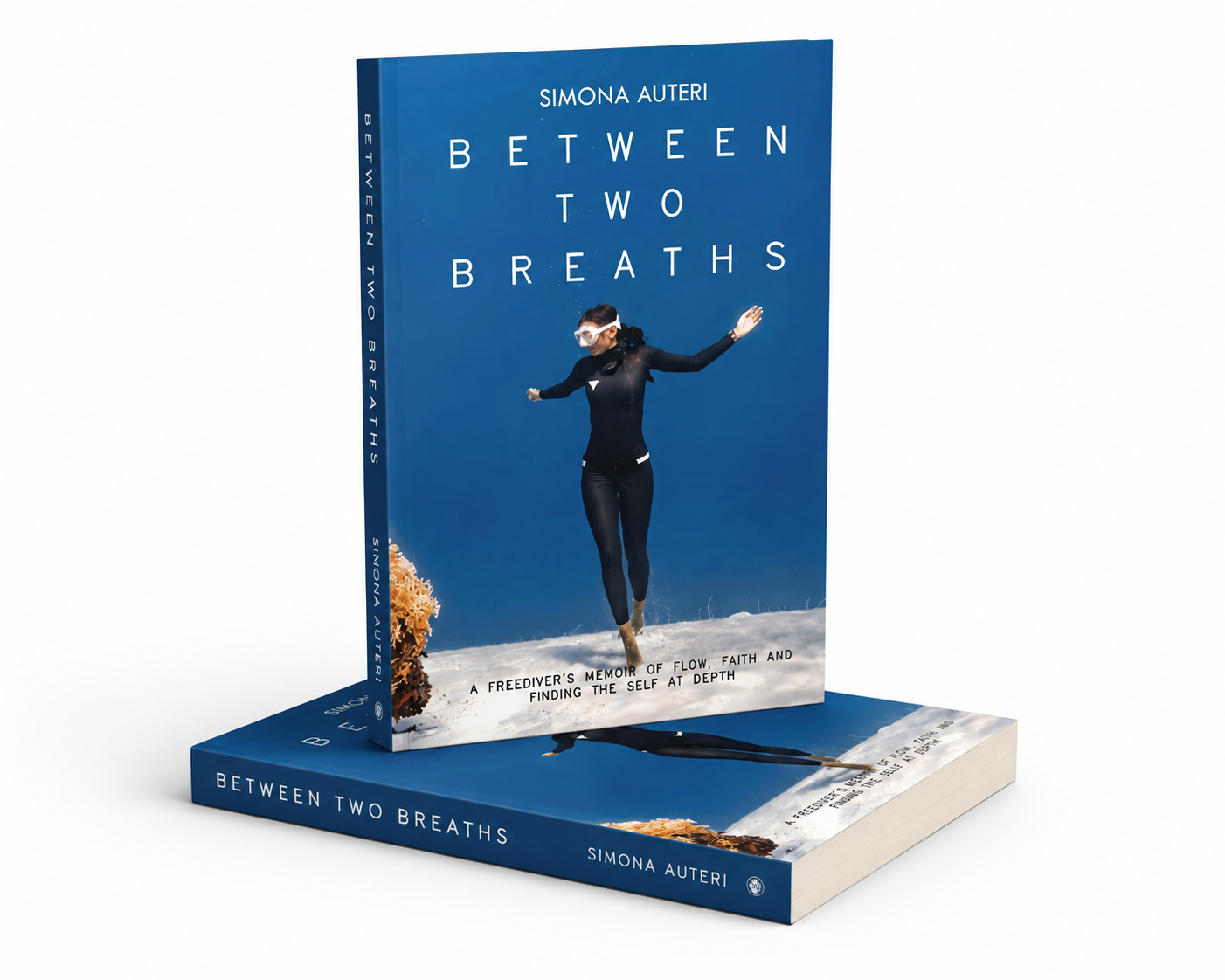
I had to visualise how the book would feel in my hands. Its weight, the images, the cover, how it would look, how the chapters would sit on the page and perhaps even how it would smell.
I wanted to imagine not only the words but the physical object itself, how it would feel to hold it, to open it, to turn its pages.
I worked with a professional book interior designer — yes, there are interior designers even for books! — who took my already good first edition of 50 copies and made it look truly professional.
And when I finally held the finished book in my hands, it felt like something I already knew, because I had imagined it so many times before.
The Wonderful Impracticality of Creativity
So architecture and writing a book share much of the same creative process, although there are some differences.
In architecture, the fun, creative part sometimes lasts about a week, and then it becomes endless hours with engineers discussing plant space.
And I'm not talking about the nice green living things that breathe and exchange oxygen with the environment, but rather those machines that make a buzzing sound and are used to generate heating or cooling.
Not quite as exciting.
Writing a book, on the other hand, allows the creative part to continue for much longer, but it's extremely impractical.
Because the best ideas always seem to come when you're moving.
You might find yourself riding a road bike when suddenly an idea appears, and you need to find somewhere to stop, in the middle of traffic, to jot it down before it's gone.
Or you wake up in the middle of the night with the perfect sentence in your head, and you know that if you don't write it down there and then, by morning it will have disappeared.
So yes, extremely impractical.
But always fun.
Because creativity is fun. Creativity is life.
And for a woman who has never had children, and likely never will, creativity is everything.
There is something deeply fulfilling about bringing something into the world that didn't exist before. About nurturing an idea, watching it grow, giving it form, and eventually letting it go.
It might be a building, a space, a painting, a film, or a book.
And perhaps that's why I've never really felt the need to choose between architecture, freediving, writing and all the other things I love doing.
They may look like entirely different disciplines, but to me they are all part of the same creative process.
It starts with an idea, a concept, something that doesn't yet exist.
And then you find the materials, you give it a structure, you imagine what it will become, and you work until it is real.
That's what I did with Between Two Breaths.
And I suppose that's what I've been doing, in one form or another, all my life.
ORDER AN AUTHOR SIGNED COPY OF BETWEEN TWO BREATHS
Order an author signed copy of Between Two Breaths!
Somewhere between effort and surrender, there is a place where breath becomes stillness.
Between Two Breaths tells the story of how a chance encounter with the underwater world transformed architect and entrepreneur Simona Auteri into a world-record freediver. Beneath the surface, where pressure rises and silence deepens, she learns how fear can become focus, and how letting go can reveal a new kind of strength.
Part personal journey and part love letter to water, the book explores the physical and mental demands of freediving, the power of breath, and the clarity found in surrendering to the unknown. In a world shaped by speed and noise, freediving becomes a practice of return - to presence, to trust and to what remains when everything unnecessary falls away.
Simona Auteri is a world-record freediver, multiple-time Italian champion, and recipient of several sporting merit awards from the Italian Olympic Committee (CONI). She coaches breathwork and mental performance techniques.